Episode 6 · 17 min
What the angels take
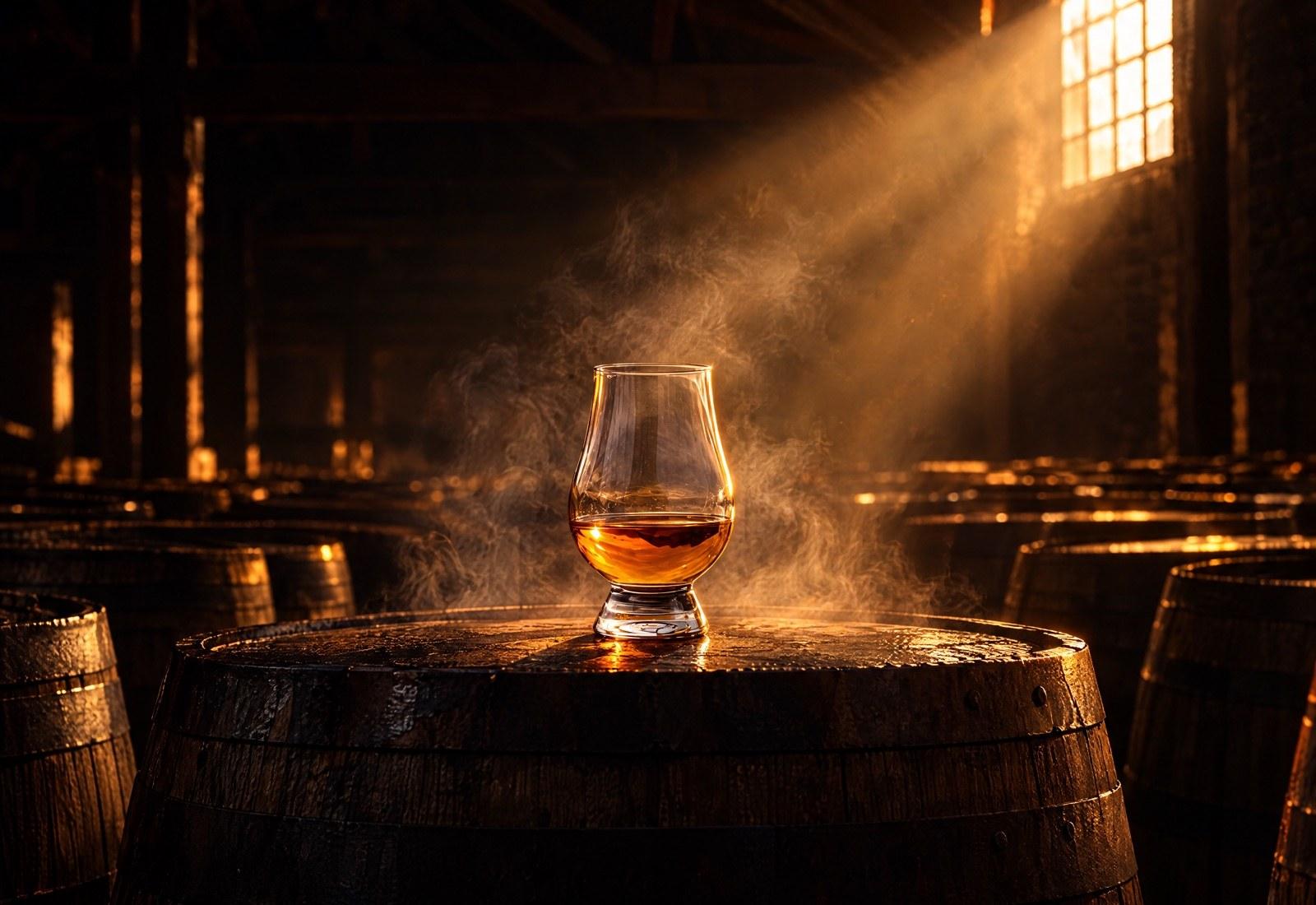
What happens to whisky while it waits in the dark. The cask that breathes, two percent a year in Scotland, why the angels take alcohol as well as water, and how India, Taiwan and Kentucky change the story.
Chapters
- 0:00What goes missing
- 1:14A cask that breathes
- 2:26Two percent a year
- 3:42They take alcohol too
- 5:37The 40 percent line
- 6:51Does local climate matter?
- 8:09Heat and India
- 10:30Taiwan
- 12:26Kentucky
- 13:36Humidity decides
- 15:24Taste the difference
Transcript
What goes missing
Imagine you fill a beautiful oak cask with new whisky in Scotland, right? And you leave it sitting in a quiet, dark warehouse for 10 years. When you finally come back to it and pull the bung, a fair slice of that liquid is simply gone. I mean, nobody drank it and nothing leaked out onto the floor. It just floated out through the wood and disappeared into the air. Yeah, and distillers actually have a rather beautiful poetic name for that missing whisky. They call it the angel share. Right, exactly. And so I want you to imagine that exact same cask being filled in Taiwan or, you know, in Southern India where it is hot all year round.
If you come back to it after just a few years there, well, far more has vanished. Yet the whisky that is left behind in that cask tastes significantly older than its actual age. Right, so today we are going to explain exactly what these angels take, what they leave behind, and why the weather outside decides so much of what happens inside. Welcome to Episode 6 of Between Drams. If you were with us last time, we were looking at how to read a whisky label, getting into things like age statements, single malt, and cask strength.
And this time we follow the whisky into the quiet of the warehouse and we ask,
A cask that breathes
what actually happens to it while it waits in the dark? But before we open those warehouse doors, I should state simply that we are AI Voices and that the stories we share with you are real and checked. Yeah, that's right. So to understand what happens to whisky while it rests, you have to first understand that a whisky cask is not a sealed environment. Well, it isn't like a glass bottle where the liquid is trapped indefinitely. You know, the oak used to make the cask is slightly porous, which means the cask actually breathes. So in the very first few days after it is filled, the wood itself acts like a sponge and physically soaks up a portion of the new spirit into its staves. Right. And then over the long years that follow, a little of the liquid slowly slips out through the wood as vapor and a little air gets in from the outside. Exactly. That very slow, constant exchange is a fundamental part of how whisky matures. I mean, the spirit is constantly being nudged by its interaction with the wood and by the air that enters the barrel. And the part of the liquid that successfully leaves the cask as vapor is what we call the angel's share. Yeah. So if we look at Scotland, the usual figure quoted is about a 2 percent loss of the cask's volume each year. It is sometimes a little less
Two percent a year
depending on the specific warehouse, but 2 percent is the standard benchmark for that climate. Wow. I mean, that 2 percent figure sounds so incredibly tiny when you just hear the number in isolation. It sounds like a rounding error, right? Something a distillery accountant would write off and ignore. But when you apply it to a product that sits undisturbed for decades, well, the compounded reality of that loss is honestly staggering. Oh, absolutely. If you lose 2 percent every single year, over 10 years, you are looking at roughly a fifth of the entire cask that has just vanished into thin air. A fifth. And if you leave it for 30 years, you are getting close to losing half of the original liquid. I mean, that is half the atmosphere. Right. And we treat those as a rough picture rather than an exact measurement for every single cask. But it is wild to think about the physical volume of whisky just floating around in the rafters of a Scottish warehouse. It really is. It represents a massive amount of time, effort, and potential revenue that distillers just have to accept as meant for the angels.
Yeah. It is a significant physical and financial loss over time, which is why Scotland's climate is such an ideal place to be patient. You know, the air there is famously cool and damp,
They take alcohol too
which means the whisky matures very slowly and gently. Right. So because the climate is so temperate and forgiving, the cask is only losing that relatively small amount each year. That allows producers to age their spirits for 10, 20, or even 30 years without the cask running completely dry. Exactly. But there is a second equally important thing that angels take in Scotland, and this is the mechanic that often surprises people the most. The evaporation isn't just a simple loss of total volume. They don't just take the liquid indiscriminately. Wait, what do you mean? What else are they taking? They take alcohol. Really? That feels like it defies basic logic. When you think about evaporation in everyday life, you naturally assume that water is the first thing to leave, which would mean the remaining spirit should be getting stronger and more concentrated over time. You would think so, yeah. But the reality is quite different. It is genuinely surprising to learn that the angels in Scotland are actively taking the alcohol, making the whisky weaker and weaker as it sits there year after year.
It completely flips the expectation of what aging does to a spirit. It definitely feels counterintuitive at first glance, but it comes down entirely to the environment directly surrounding the barrel. In the damp air of a Scottish warehouse, the environment is already holding a lot of moisture. Okay, so because of that dampness, the alcohol tends to escape from the cask a little more easily than the water does. Exactly. So as the decades go by, the overall alcoholic strength of the whisky slowly slips downward. The commonly quoted rate for this drop in Scotland is about half a percentage point of strength per year. Wow. So that continuous slow loss is exactly why a cask-strength Scotch that comes from a very old 30-year-old barrel can actually emerge far weaker than a young, punchy 5-year-old whisky. The longer it sits in that
The 40 percent line
cool, damp environment, the more alcohol those angels carry away. Right. But that creates a terrifying legal and financial tightrope for the distillers. Scotch is usually filled into the cask at a starting strength of around 63%. But legally, to be called Scotch whisky, it has to be at least 40% alcohol by volume when it is finally bottled. And it has to be at least three years old, right? Correct. So if a cask is losing half a point of alcohol every single year, a really old whisky is constantly creeping closer and closer to that legal floor. That means distillers must have this invisible countdown clock ticking in the background. If a precious 30- or 40-year-old cask drops below that 40% line, it literally ceases to be Scotch by law. It's just ruined, at least in terms of selling it as a single malt Scotch whisky. That is exactly the reality they face. If a cask drifts below 40%, it is in real trouble. It can no longer legally be bottled and sold as Scotch, which is a heartbreaking end for a liquid that has been carefully tended for decades. So they really have to monitor their older, most valuable stock very carefully to ensure the strength doesn't accidentally dip below that legal threshold. Yeah. And the environment
Does local climate matter?
where the cask sits plays a huge role in how fast this happens. And there is an ongoing, fascinating debate about how much local geography matters within Scotland itself. For instance, Simon Erlanger, who helps run the Isle of Harris distillery, has pointed out that it does rain a little on Harris. Just a little. Right? And that the summer there is only slightly warmer than the winter. He thinks both of those highly localized factors help the wood give up its flavor to the spirit in a unique way. But that hyper-local sort of terroir-driven view of maturation isn't universally accepted, is it? You have people on the other side of the industry, like Diageo's Dr. Nick Morgan, taking a much broader, perhaps more pragmatic view.
Yes, he argues that Scotland's sea-influenced climate is actually fairly consistent, whether your warehouse is sitting right on the coast, perched on a hill, or tucked away down in a glen. His argument is that those small local differences between sites hardly matter at all over the full life of a whisky. Exactly. But everyone seems to agree that the gap between Scotland and and a hot country is an entirely different universe. Yeah. Well, we've spent a lot of time in this cool, damp, slow maturation process, but I want to take us somewhere hot, because warmth changes the equation entirely, and heat just speeds up absolutely everything. It certainly does.
Heat and India
When the surrounding temperature rises, the liquid inside the barrel becomes much more active. It moves in and out of the wood much faster, extracting flavor at a highly accelerated rate, and significantly more of it escapes into the air as vapor. Let's look at Bangalore in southern India, which is the home of the Amrut Distillery. The reported evaporation there is staggering, sitting around 10% to 12% a year. Which is massive. If you compare that with the 2% baseline in Scotland, you see that the angels in India are taking several times as much liquid every single 12 months. The impact on the spirit is profound. Yeah. Amrut's master blender, Surinder Kumar, has said that one year of aging in India is worth about three years of aging in Scotland, in terms of the interaction with the wood. And the angels in India are taking so much volume that Amrut actually named a specific whisky after the phenomenon. They have a highly sought after limited bottling called Greedy Angels. I love that. The distillery says the name is simply because the angels there are quite greedy, which is honestly the perfect way to describe a 10% to 12% annual loss. It really is. One of their releases under that label was a 10-year-old whisky bottled at 55%, which was made specifically to celebrate the 60th birthday of Amrut's chairman, Neel Jagdale. When you do the math on that evaporation rate, getting a whisky to 10 full years old in that Indian climate without the cask emptying completely is a massive logistical achievement. I mean, you're fighting the environment every single day to keep anything in the barrel at all. It is a delicate balancing act that requires constant vigilance, for sure.
And this intense evaporation isn't just isolated to Bangalore. Further down India's west coast, you have the Paul John Distillery in Goa. Oh, right. Yeah. The team there puts their angel share at about 8% to 10% a year. Michael D'Souza of Paul John has estimated that four to five years in Goa is worth around 15 years in Scotland when you look at the maturity of the liquid. Now, it is important to clarify that these figures are the producer's own estimates, not strict laboratory measurements, but the overall pattern is incredibly clear, right?
Absolutely. The distillers operating in these hot climates all report the same dramatic acceleration in how quickly their whisky takes on the characteristics of the oak. And it isn't just India dealing with these massive evaporation rates and accelerated timelines.
Taiwan
Taiwan is another fascinating example that really pushes the boundaries of what a cask can endure, specifically the Kavalan Distillery in Yilan, which is located on the east coast. Yeah, the climate there is subtropical, meaning it is incredibly humid and intensely warm. A visitor to the distillery was told that the angel share there normally runs at 10% to 12% a year, just like we saw in Bangalore. But they were also told that after a particularly hot summer, that loss can reach as high as 18% in a single year.
Losing nearly a fifth of a barrel in just 12 months is hard to even comprehend when you're used to the Scottish model. It really is. The temperature extremes at Kavalan are remarkable, especially when you look at the physical structures where they store the casks. I mean, they use a massive five-story warehouse to hold their barrels. Oh, wow. Yeah. In the peak of the Taiwanese summer, the top floor of that building can reach about 42 degrees Celsius. Meanwhile, the ground floor stays much cooler, sitting near 27 degrees.
That trapped, sweltering heat drives a massive amount of interaction between the spirit and the oak. The usual story you hear from people tasting these expressions is that this intense heat gives Kavalan an older, much more developed character than its actual years would ever suggest. And the way that intense heat changes the spirit is so visceral. It requires a completely different to describe. One person on a distillery visit described that subtropical heat as acting like sandpaper. I think that is such a brilliant, vivid description. They said the heat acts like sandpaper, aggressively sanding away all the rough, youthful edges of the new spirit until the resulting whisky is incredibly soft and round.
It gives you a real sense of the climate actively working on the liquid, almost forcefully shaping it and beating it into maturity rather than just gently resting alongside it for decades like they do in Scotland. It is an undeniably aggressive maturation process. But if we want to find a middle ground between the gentle, patient resting of Scotland and the aggressive sanding of the Asian tropics,
Kentucky
we can look at bourbon's home in the United States. Right, Kentucky. The Kentucky Distillers Association gives the angel's share for bourbon as about three to five percent a year. So it sits comfortably somewhere in the middle between the Scottish Glens and the subtropical heat. Yeah, and the loss in the very first year is often heavier than that average as the brand new wood they are required by law to use acts like a dry sponge and soaks up a good amount of the spirit immediately. Kentucky experiences hot, humid summers and very cold winters, and they use tall, multi-level structures called rickhouses to store the barrels. Because heat naturally rises, these rickhouses are significantly warmer near the roof than they are down near the dirt floor.
Which means barrels sitting in different spots within the exact same building will mature at very different speeds. Precisely. And this is where we need to look at how humidity plays into the overall equation. Because understanding the air moisture flips our earlier conversation about losing alcoholic strength completely upside down. Oh, right. In Kentucky, depending on the warehouse conditions, you can actually see the strength of the spirit go up over time. Which, again, feels like absolute magic when you are conditioned by the Scottish rules where the whisky always
Humidity decides
gets weaker. It fundamentally changes how a master distiller has to plan their eventual bottling. It is all about the moisture in the air surrounding the barrel. In hot, dry air, it is the water inside the cask that tends to escape faster through the wood. Oh, so because the water leaves the barrel and the alcohol stays behind, the overall alcoholic strength of the whisky inside can actually go up. Exactly. Contrast that with cool, damp air, as we saw in Scotland, where the alcohol escapes faster and the strength naturally goes down.
This dynamic is exactly why people commonly say that bourbon can get stronger in the cask while scotch gets weaker. Right. But it is vital to remember that this is a tendency, not a strict rule. It depends entirely on the microclimate of the air immediately around the barrel and on exactly where in the rickhouse it sits. Yeah, and that humidity rule is the perfect key that ties this entire journey together because you can apply that exact same logic right back to India to see it working in real time.
Oh, I see. At Amrut in Bangalore, where the air is noticeably drier, the strength of the whisky goes up over time. It increases by more than two percentage points after just three years in the cask. Right. But if you travel down to Paul John in Goa, the coastal air is heavily humid. There, the strength goes down. The distilleries team has described filling whisky into the cask at 63%, only to find it sitting around 58% after five years. So it is the humidity, not just the heat, that ultimately decides whether those angels are flying away with mostly water or mostly alcohol.
That is precisely the mechanism at work. The temperature acts as the driving force, determining the speed of the maturation and the total volume of the evaporation. But the humidity acts as the director, deciding which specific elements escape
Taste the difference
and the direction the alcoholic strength will travel. It is a brilliant, entirely natural system that gives every region its own unique signature. It really is. You can actually taste this entire concept for yourself at home by putting two very different bottles side by side. I highly recommend pouring a scotch that is about 12 years old and tasting it right beside something young from a hot country. Yeah, you could use an expression from Amrut or Paul John from India or a Kavalan from Taiwan. When you taste them together, notice how much deep richness and heavy wood influence the young hot climate whisky has for its age compared to older, slower matured scotch.
And if you ever have the rare chance to find it, try the Amrut Greedy Angels for the full, unfiltered effect of what a hot climate can do to a barrel. Definitely. When you taste it, ask yourself a question. Does this taste more like a long, gentle sleep or a quick sunburn? And remember, if a whisky from this episode catches your ear, you can look it up in Dramour and save it. Well said. Next time on Between Drams, we have an episode called Whisky by Numbers. We will be looking at the Scotch Malt Whisky Society.
Oh, that's a great one. Yeah, they were founded in Edinburgh in 1983, and they have a very unique approach to the industry. They bottle single casks with a numeric code instead of a distillery name. Right. And they also happen to write some of the strangest and most wonderful tasting notes you will find anywhere in the world of whisky. It is going to be a lot of fun unpacking those mysterious codes and figuring out those wild tasting notes actually mean. Absolutely. Until then, thank you for joining us. We are Between Drams, wishing you a great rest of your day wherever you happen to be listening.
Listen in the app
Pour along at home.
In Dramour, Between Drams plays on in the mini player while you browse, with live captions and chapters to jump between.