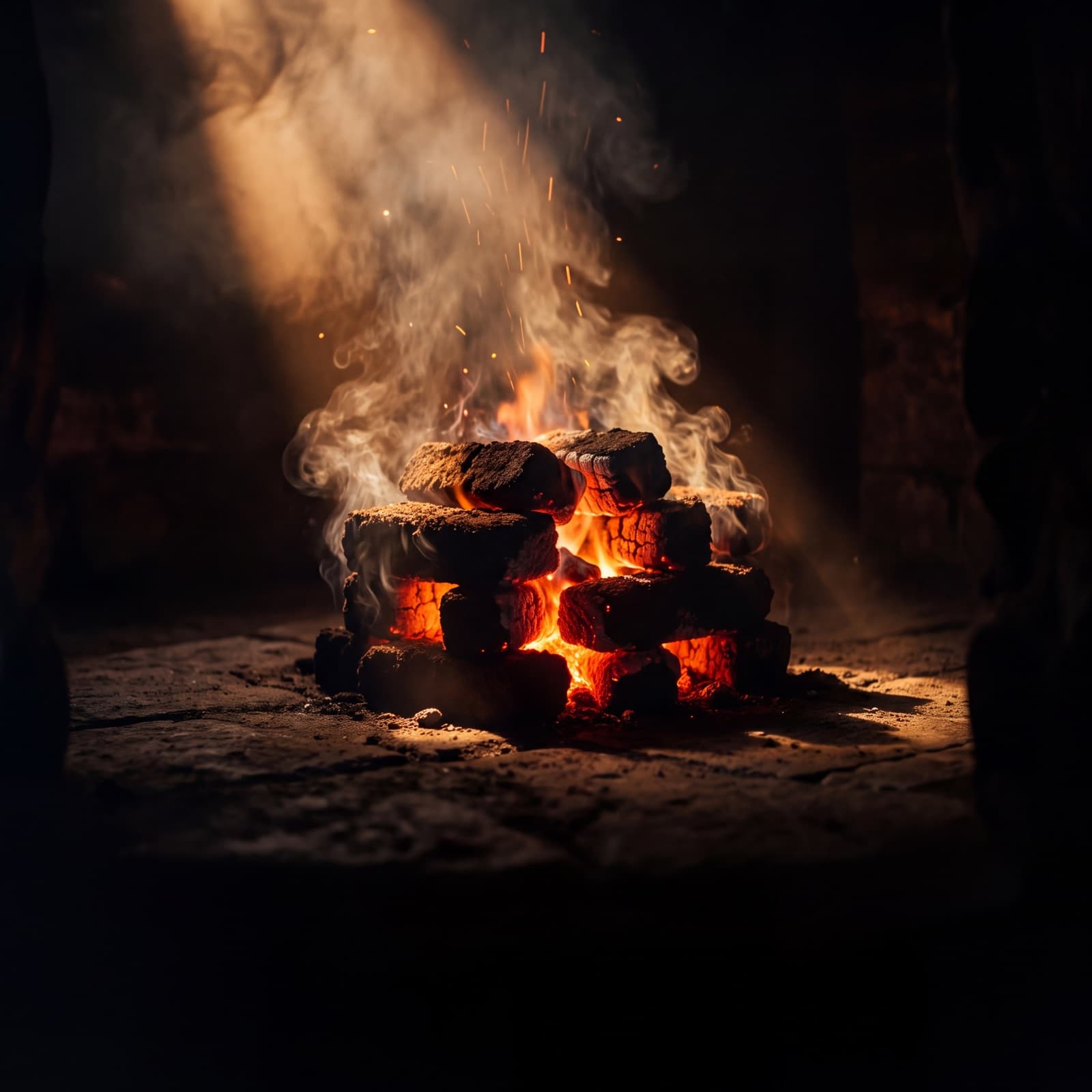
Episode 2 · 16 min
Where the smoke comes from
Why some whisky smells of bonfires and the sea. Islay's treeless shore, peat that builds up a millimetre a year, smoke caught in damp barley, and the Laphroaig fans who rent a square foot of bog for a dram. Then a gentle way into smoky whisky.
Chapters
- 0:00A bonfire in the glass
- 1:54Islay
- 2:31What peat is
- 4:26The taste of the shore
- 5:03How smoke gets into the barley
- 6:19Parts per million
- 6:58What the cask does to smoke
- 8:08Why only Islay kept peat
- 10:34Not all Islay is smoky
- 11:10Laphroaig stories
- 12:26Getting into smoky whisky
- 14:21Two famous numbers
Transcript
A bonfire in the glass
Pour a glass of Laphroaig or Ardbeg and something remarkable happens. Before you've even tasted it, before the glass is anywhere near your lips, the smell just reaches you across the room. You get this heavy, lingering scent of a bonfire, thick tar and seaweed drying on a cold beach. Sometimes there is even a sharp note that reminds you of a hospital or a freshly opened box of plasters. It is completely unmistakable. People almost always have a profound, immediate reaction to it, where they either love it on the very first sip or, well, they pull a face, push the glass away and don't try it again for years. It's a completely singular experience in the world of drinks.
And almost everyone who encounters it ends up asking the exact same question. How does smoke get into a drink that is made of nothing more than barley, water and yeast? It really all comes down to a fire, a very old kind of fuel and a small, rugged island situated off the west coast of Scotland. This is episode two of Between Drams. If you joined us for episode one, you'll remember that we followed a single grain of barley all the way from the field to the glass. But we deliberately skipped over one crucial thing that happens at the kiln and that is the fire.
Today we are filling in that missing piece. And just before we set off, it is important to mention plainly that we are AI voices and the stories we share are real and checked. Now, I have to admit something right up front. I have always been a bit wary of that intense medicinal box of plasters flavor we just described. It can feel like an assault on the senses and I've never quite understood how people sit back and relax with a glass of it. I completely understand the hesitation. I really do. It's a bold and challenging profile.
It doesn't apologize for what it is, but I happen to absolutely love it. And I'm hoping that by the end of our conversation today, I can help you see the appeal.
Islay
I am definitely open to being convinced. So to understand that distinct smell in the glass, where do we actually start? You really have to understand the place it comes from. So we have to travel to Islay. Islay is a low, incredibly windy island in the inner Hebrides. It's about 25 miles long, humped at just a few thousand people. And yet it holds an outsized reputation in the whisky world. You just have to picture a rugged, beautiful coastline battered by the Atlantic. Down on the rocky south coast, you have this legendary cluster of distilleries, don't you?
You do. Yes. Lagavulin, Laphroaig, and Ardbeg sit right on the water within just a few miles
What peat is
of each other. Then if you travel up to the middle of the island, you find Bowmore sitting quietly on a sea loch, subject to the exact same coastal winds. It sounds beautifully desolate, but it also brings up an obvious contradiction. If whisky is essentially an agricultural product made from grain, why does a rugged island with very few trees produce the most famous whiskies in the world? The answer lies entirely beneath your feet when you walk across that island. Because the answer is peat. Peat is exactly what you get when plants die in wet, cold, boggy ground and never properly rot. Because the ground is so waterlogged, there is very little oxygen.
So the normal process of decay simply stops. Oh, wow. So it just sits there and accumulates. Exactly. It just accumulates. Over thousands of years, mosses, heather, and roots pile up on top of one another and press down into the earth. It is a tremendously slow process, building up at roughly a millimeter a year to create this incredibly dense layer in the soil. When you describe it building up at just a millimeter a year, it makes me think of a peat bank as a dense, earthy time capsule. If you take a spade and slice down into the bog, you are quite literally cutting through thousands of years of the island's history with a single stroke.
You are slicing right through history, which is a lovely way to look at it. And if you get that peat out of the ground, stack it up, and let the fierce island wind dry it out, it burns remarkably well. On islands where there are no vast forests to chop down for firewood, peat was the essential everyday fuel for cooking and heating homes for centuries. So when the local people needed to dry their harvested barley to make whisky, they naturally just dried it over a peat fire. The smoke was never intended to be like a deliberate flavor choice. It was simply the only fuel they had available.
The taste of the shore
That is exactly right. It was pure practicality. And importantly, peat from different places smells completely different when it burns because completely different plants went into making it over those millennia. Islay peat formed very close to the sea, with heavy salt spray blowing over the bogs day in and day out. I imagine that salt spray has a huge impact on the final flavor. It has a massive impact. That maritime influence is exactly why Islay whisky tastes not just of smoke, but of the shoreline itself. It produces heavy notes of seaweed and iodine, which is a completely different aroma from the woody smoke of peat found further inland.
How smoke gets into the barley
Knowing that the island is covered in this combustible earth explains the fuel source, but I still don't quite get how burning dirt translates into an actual flavor in a clear liquid. Just as a quick reminder from our last episode, to make malt whisky, the barley is first soaked in water to start sprouting. Then you have to stop that sprouting process by drying the grain in the kiln. This is exactly where the island's earth gets inside the liquid. Picture a traditional kiln filled with thick, billowing smoke from a peat fire lit in the furnace down below.
The barley resting on the mesh floor above is still very damp from being soaked in water. Ah, so the dampness of the barley is what catches the smoke? Yes, that moisture is the key. Water acts as a solvent for the heavy, oily phenolic compounds that are carried up in the peat smoke. Because the grain is wet, the thick smoke clings directly to the husks, and those aromatic oils bind tightly to the barley. That makes perfect sense. Do they have a way of measuring exactly how much of that smoke the malt is soaked up?
They do, and they measure it in parts per million. To give you a sense of scale, lightly peated malt might sit at just a few parts per million. When you get to the heavy hitters
Parts per million
we mentioned earlier, like a Laphroaig and Ardbeg, you are well into the tens. Even the tens taste pretty intense, so I can't imagine going higher than that. Well, Bruichladdich produces a specific range called Octomore, and that has been known to push past 300. 300? That is absolutely staggering. Doesn't a number that high just completely overpower the entire brewing and distilling process? I mean, I can't imagine how any characteristic of the actual barley survives an onslaught of smoke like that.
You would think so, but the reality of the process is much more forgiving. Those smoky,
What the cask does to smoke
oily compounds stay with the grain all the way through the mashing, the fermenting, and distilling, but plenty of them are naturally lost along the way. And, you know, the most interesting transformation happens during maturation. What happens to the smoke when it sits in the cask? The time the whisky spends sitting in an oak cask softens the smoke dramatically. The compounds are volatile, and over decades of interacting with the wood and the tiny amount of oxygen inside the barrel, they literally break down. That is why a very old, peated whisky tastes surprisingly gentle.
So it doesn't just get smokier and smokier as it sits in the dark? Not at all. Over the decades, the aggressive, fiery smoke recedes into the background. It ends up sitting quietly behind elegant notes of orchard fruit and wood, rather than shouting at you from the front of the palate. The idea that decades in a barrel breaks down the chemical compounds of the smoke makes a lot of sense. But if drying barley over a peat fire was just the standard, practical way to do things across Scotland for centuries, why did the rest of the country stop? Why is this intensely smoky flavor now almost entirely associated with just this one specific island?
Why only Islay kept peat
It really comes down to geography and the slow march of modernization. To understand the shift, you have to picture how things used to be done everywhere. Imagine a traditional malting floor, a massive, humid room where wet barley is spread out across a stone floor. It sounds like it would require a massive amount of physical labor. It certainly did. Workers had to walk through it day and night, turning the heavy, damp grain by hand with wooden shovels to ensure it didn't rot while it sprouted. Today, most distilleries on Islay actually buy their malt from the large Port Ellen maltings on the island, which can peat it to any requested level.
Are there any distilleries that still turn the barley by hand? A few places hold on to the past, yes. Bowmore and Laphroaig both still maintain working turning the grain by hand just as they did centuries ago. There's also a wonderful small farm distillery called Kilchoman, which goes a step further by growing and malting some of its own barley right there on the farm. So the old methods required an incredible amount of backbreaking labor. But that still leaves the question of the fuel. If everyone had to dry their grain, and peat was free and widely available, why did the mainland distilleries abandon it?
They abandoned it the moment a better option arrived. As the Victorian railways pushed through the highlands and better roads finally reached the mainland, they brought coal and other modern fuels with them. Coal is far more efficient, it burns hotter, and it burns much cleaner. I suppose it also doesn't require a team of men to spend weeks out on the moors cutting it and hauling it back. Once the mainland distilleries had access to cheap coal via the trains, they simply stopped relying on the bogs. And without the peat smoke, their whiskies naturally became lighter and cleaner.
Precisely. Islay, however, was a remote island surrounded by rough seas. Bringing heavy shipments of coal across the water was expensive and unreliable. Meanwhile, they had massive bogs of peat sitting right on their doorstep. So the smoky style stayed on Islay out of pure, stubborn necessity. There's a real poetry to that historical shift. Something that started purely as a geographical necessity, a simple lack of other options, eventually became the island's defining identity to the rest of the world. Though there is a surprising fact that contradicts the stereotype that everything from Islay tastes like a liquid bonfire. Not all Islay
Not all Islay is smoky
whisky is smoky. It always surprises people when they visit and learn that fact. Bunnahabhain, for example, is situated right there on the coast, but they are known for a very soft, nutty, beautifully sherried style of whisky that is mostly unpeated. And then you have Bruichladdich. Wait, didn't you just say Bruichladdich makes that extreme heavy peat octamore? I did. But the distillery's main everyday whisky is entirely unpeated. They focus heavily on the providence of the barley itself rather than the smoke. So while the word Islay is absolutely synonymous with heavy peat for most drinkers, you really can't apply that
Laphroaig stories
brush to every single drop made on its shores. Still, the intense, divisive flavor of the smoke that is made there has inspired some incredible legends over the years. One of my favorites is the famous story about Laphroaig during Prohibition in the United States. As the story people tell goes, it was actually allowed to be legally imported into the U.S. as medicine. That is such a fantastic piece of whisky lore. Because of its intensely medicinal, iodine-like taste, it supposedly managed to persuade customs officials that it was meant for the pharmacy, not the bar. Regardless of whether every detail of that paperwork is a historical certainty, it perfectly illustrates just how intense that flavor profile really is.
It speaks to the fierce, almost tribal loyalty that these medicinal flavors inspire. And that loyalty goes far beyond just buying a bottle and drinking it at home. Laphroaig actually has a famous fan club called the Friends of Laphroaig, doesn't it? It does, and it is a brilliant initiative. When you become a member, you are given a lifetime lease on a single square foot of land on Islay. The catch, which is a lovely one, is that your yearly rent is paid in a dram of whisky. But you only get it if you visit the distillery in person to claim it.
Getting into smoky whisky
I love the dedication that requires from the fans. Picture whisky lovers turning up on the island in heavy wellies, holding a physical map, trekking out into the damp fields to find their exact square foot of Islay mud. It really shows how much this specific liquid means to people. It really does command that level of passion. But as the resident skeptic in this conversation, I have to ask you for some practical advice. If someone hated their first sip of a heavily smoky whisky, how should they actually approach it to give it a fair and proper chance? Is there a trick to getting past that initial wall of smoke?
The most important thing is not to rush straight to the most intense bottles. The first sip of a heavy peat monster can be a genuine shock to the system. So the secret is to take a gentle, progressive path. I always recommend starting with something lighter, perhaps a Caol Ila or a Bowmore. Okay, so start somewhere where the smoke is polite and balanced by citrus or dark fruit. Where do you go from there once you are comfortable? Then you move up to Lagavulin 16 to experience a beautiful, rich and rounded smoke without the sharp medicinal edges. Only after your palate understands those should you finally pour the intense, tar-heavy Laphroaig 10 or Ardbeg 10. And once you have that glass poured, there is a specific way you should drink it.
I am taking mental notes here. What is the method? First, add a single drop of water to the glass and let it sit undisturbed for a full minute. Then, employ the two-sip rule, which is vital for anyone struggling with peat. When you take that first sip, your brain is just going to register the shock of the smoke, like an alarm bell. So you just swallow it, wait a moment, and then go straight back for a second sip? Exactly. Because on that second sip, the shock is gone. Your palate has adjusted to the smoke and you can finally taste the actual whisky sitting underneath it.
Two famous numbers
That is where you find the underlying sweetness, the rich vanilla from the oak, and the coastal salt from the sea air. The two-sip rule. I will definitely keep that in mind the next time I am faced with a glass of the heavy stuff. Letting the brain get over the initial alarm bell makes perfect sense. I highly recommend it for your next tasting. Just as a fun aside for anyone listening who enjoys collecting, the Scotch Malt Whisky Society hides the identity of the distillery behind a numbering system.
Two of the most famous Islay heavyweights have iconic numbers. Ooh, I've seen those dark green bottles before. Which numbers should people look out for? Number 29 hides Laphroaig and number 33 hides Ardbeg. Spotting those specific numbers is always a thrill for a fan of the smoke. If a whisky from this episode catches your ear, you can look it up in Dramour and save it for later. And looking ahead, I am very excited to say that episode three is going to explore another massive influence on the flavor of whisky. We will be talking about where the Christmas cake comes from. Sherry casks. We're going to trace the history of thrifty Scottish distillers who started reusing the empty casks shipped over from Spain to Britain.
I am very much looking forward to that. We will leave you with this thought to mull over the next time you pour a Dram. When that unmistakable scent of a bonfire or a sea-swept shore rises from your glass, you aren't just smelling a style of whisky. You are breathing in the ancient, wind-blown earth of a Scottish island and thousands of years of history, entirely transformed by fire. Until next time, this has been Between Drams.
Listen in the app
Pour along at home.
In Dramour, Between Drams plays on in the mini player while you browse, with live captions and chapters to jump between.